
AI-Enabled CROs: Hype vs. Reality, What Biotech Startups Should Know Before Signing Up
- Philip Gorman
- Feb 20
- 5 min read

Every antibody discovery CRO deck I've seen in the past 18 months has at least one slide with "AI-enabled" or "ML-powered" stamped across it. Some of these claims are legit. Others are... creative marketing.
If you're a biotech startup evaluating vendors, you need to separate signal from noise fast. AI can absolutely accelerate parts of your antibody campaign, but only if you know what it can (and can't) realistically do, and if you structure the engagement correctly.
Here's what you should actually expect, what questions to ask, and how to set up a pilot that protects your timeline and budget.
What AI Can Actually Do Today (In Antibody Discovery)
Let's start with the realistic wins. AI and ML tools have matured enough to deliver measurable value in specific areas of antibody discovery. These aren't theoretical, they're live capabilities you can leverage right now.
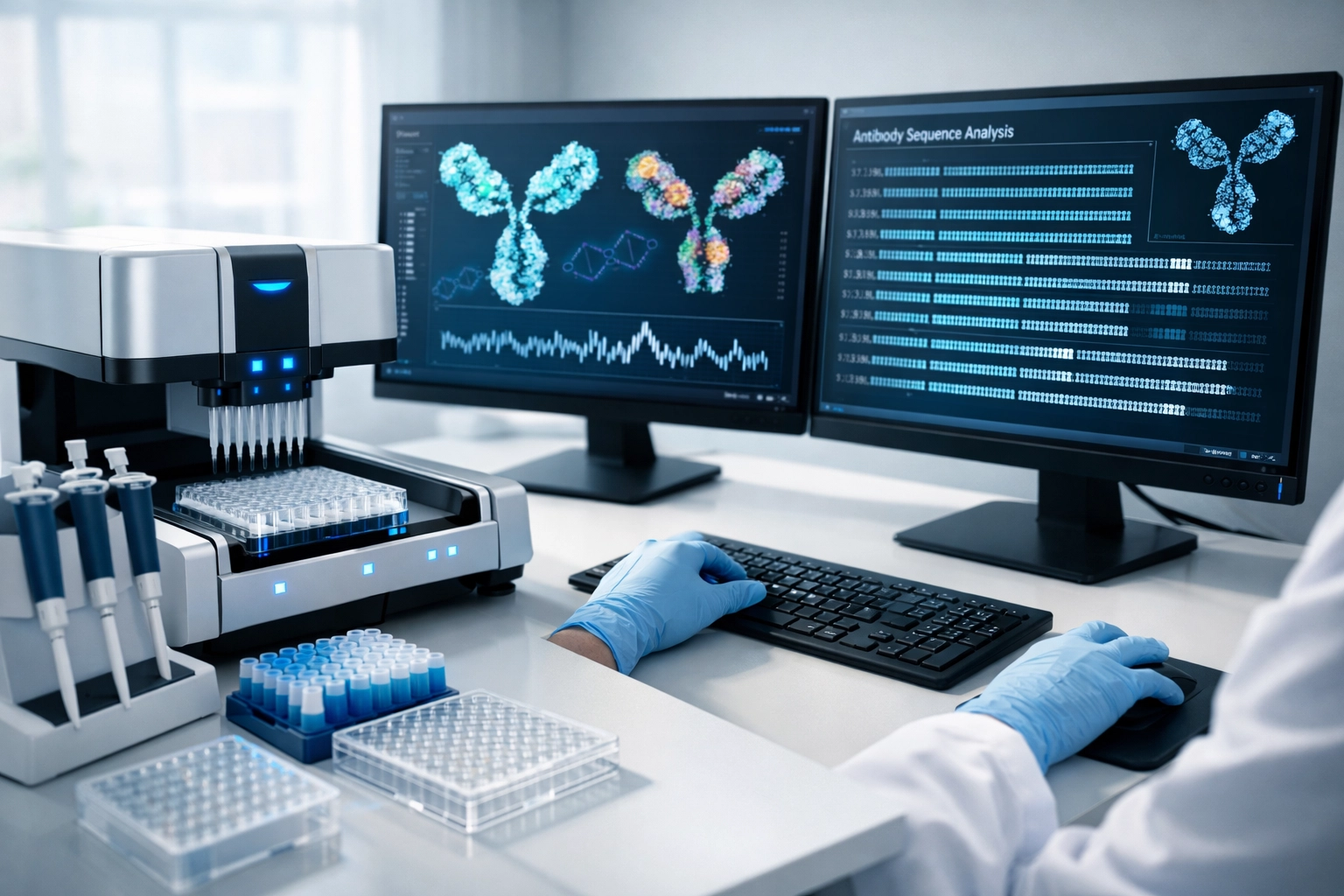
Hit identification and sequence optimization: AI models trained on large antibody datasets can predict binding affinity, developability liabilities (aggregation, viscosity, immunogenicity flags), and even suggest sequence mutations to improve stability or expression. This works best when the CRO has proprietary training data from prior campaigns. Generic models trained on public databases are less reliable.
Epitope binning and paratope mapping: Machine learning can predict epitope overlap and paratope residues from sequence alone, which helps prioritize clones early without burning through antigen or running extensive competition assays. It's not perfect, but it's directionally accurate enough to inform selection decisions.
Developability scoring: AI tools can flag red flags like deamidation sites, oxidation-prone residues, glycosylation motifs, and aggregation-prone CDR sequences. This doesn't replace wet lab confirmation, but it dramatically narrows the candidate pool before you invest in deeper characterization.
Library design and diversity analysis: For display campaigns (phage, yeast, mammalian), AI can analyze library diversity, predict coverage across epitope space, and suggest bias corrections. This is especially useful if you're doing multiple rounds of selection and want to avoid convergence to a single dominant clone family.
Data integration and decision support: AI-powered dashboards can synthesize affinity data (SPR, BLI, ELISA), expression titers, sequence liabilities, and functional assay readouts into ranked candidate lists. The best systems let you adjust weighting on the fly so you can reprioritize based on evolving program needs.
What AI Can't Do (Yet)
Now for the reality check. AI is not a magic wand, and any CRO that positions it as a replacement for wet lab work or human judgment is overselling.
AI cannot design antibodies de novo with high confidence. Full in silico antibody design, where you input a target structure and get back a functional binder without any experimental validation, is still mostly hype. The models aren't there yet. You'll still need selection campaigns or rational design starting from known scaffolds.
AI cannot predict function from sequence alone. Binding affinity? Yes, with decent accuracy. But neutralization, agonism, receptor internalization, Fc effector function: these require experimental data. AI can prioritize candidates, but it can't replace the assays.
AI cannot replace process development. Predicting that a sequence might aggregate is useful. Actually developing a stable formulation at 150 mg/mL requires real experiments. Don't let vendors skip the hard work by waving AI around.
AI models are only as good as their training data. If the CRO's model was trained on mouse mAbs and you're developing a human IgG4, the predictions will be off. Ask where their data comes from and whether it's relevant to your modality and target class.
Questions to Ask Before You Sign
Here's your due diligence checklist. These questions will separate the vendors who've actually integrated AI into their workflows from the ones who just added it to their pitch deck.
1. What specific AI tools are you using, and at what stage of the workflow? Get specifics. Are they using AI for library design, hit selection, developability screening, or all of the above? How is the output integrated into decision-making?
2. What data was your model trained on? Public databases (SAbDab, OAS)? Proprietary campaign data? A mix? How recent is the training set, and does it include antibodies similar to your target class?
3. How do you validate AI predictions experimentally? AI predictions should inform experiments, not replace them. Ask for examples of where their model flagged an issue that was confirmed in the lab: or where it missed something.
4. Who owns the data generated during the campaign? This is critical. If the CRO retains rights to use your sequences and assay data to retrain their models, you need to know upfront. Data ownership clauses should be explicit in the SOW.
5. Can I access the raw AI outputs, or just the final recommendations? You want transparency. If they're filtering candidates through a black box and only showing you the top 10, you lose the ability to make informed trade-offs. Ask for scoring matrices, confidence intervals, and the ability to reweight priorities.
6. What happens if the AI predictions don't hold up? Is there a fallback plan? How do they course-correct if the developability score was wrong or the predicted epitope was off? You need to see their contingency workflow.
7. How much does the AI capability add to the cost? Some CROs bundle AI into their base pricing. Others charge a premium. Make sure you're not paying extra for tools that should be standard in 2026.
Structuring a Pilot: Start Small, Define Success
If you're testing an AI-enabled CRO for the first time, structure a pilot that lets you evaluate their capabilities without betting the entire program.
Pilot scope: Run a single selection campaign or a lead optimization exercise on a defined set of candidates (10–20 clones). This is enough to assess their AI tools, turnaround time, and communication without committing to full-scale development.
Success metrics: Define these upfront and put them in the SOW. Examples:
AI model correctly predicts rank order of affinity (top 5 binders)
Developability predictions align with expression titer and aggregation data
Epitope binning predictions confirmed by competition ELISA or HDX-MS
Turnaround time for AI-assisted selection is 20%+ faster than standard workflow
Data ownership and access: Negotiate data rights before you start. At minimum, you should own all sequences, all raw assay data, and have the right to use AI-generated predictions internally. Ideally, the CRO does not get to use your data for model retraining without explicit consent.
Integration with wet lab: AI predictions should feed directly into experimental decision points. For example: AI ranks 50 clones by developability → wet lab confirms top 15 → AI re-ranks based on expression data → functional assays on top 5. If the AI and wet lab workflows are siloed, you lose the efficiency gain.
Review cadence: Weekly or biweekly check-ins to review AI outputs, validate predictions, and adjust priorities. This is where you'll catch disconnects early.
Red Flags to Watch For
A few warning signs that the "AI-enabled" pitch is more marketing than substance:
Vague descriptions: "We use machine learning to optimize antibodies" without specifics on the model, training data, or validation approach.
No experimental validation: AI predictions that aren't cross-checked against wet lab data within the same campaign.
Black box scoring: You get a ranked list but no transparency into how the ranking was generated or what trade-offs were made.
Overpromising speed: Claims like "AI reduces timelines by 50%" without clear context on what's being compared and where the time savings actually come from.
Data lock-in: Contract terms that give the CRO exclusive rights to your data or make it difficult to take your sequences elsewhere.
The Bottom Line
AI is a real tool, not a gimmick: but it's an accelerator, not a replacement. The best AI-enabled CROs use it to make smarter decisions faster, not to skip steps or replace human expertise.
If you're evaluating vendors, focus on:
Specificity over buzzwords
Validation over predictions
Transparency over black boxes
Data ownership from day one
And if you're about to sign an SOW with an AI-enabled CRO and want a second set of eyes on the terms, data rights, and success metrics: book 30 minutes. I've reviewed enough of these agreements to know where the landmines are buried.
Comments